
My perspective on the homeless has seen many vantage points over the years. I have always had compassion for the misfortune of others, but today I reached a new summit with a beautiful view of the oneness we all share.
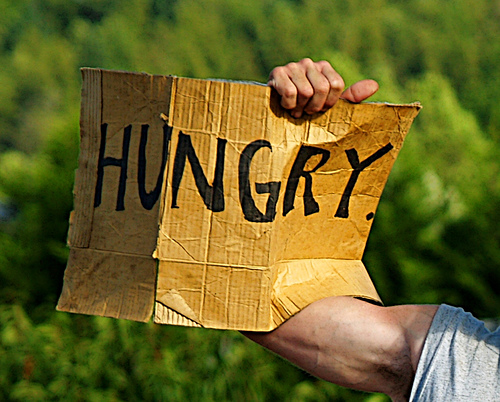
Just last night I participated in an online workshop/meditation on abundance, lead by Rev. Michael Bernard Beckwith. It was a beautiful session that set my mind and body into a vibration of mindfulness, surrounding prosperity. And then right away this morning — of course — as I was waiting peacefully in a long line of cars at a highway on-ramp, I saw a homeless man bundled up in the cold, asking for money. The message on his cardboard sign was simple enough. It read, simply, “hungry.”
I spent a moment studying the man from afar, feeling like I should dig out my wallet and exhume a couple of dollars. I often do this, but this morning I felt more compelled than normal. So I acted promptly.
As I approached this fellow human being, I rolled down my window and nodded at him to come over before the light changed. I looked into his eyes, handed him the money, and said “I see you. Have a blessed life.”
He stared at me very intensely for what seemed like eternity, but was in reality maybe a few seconds. He thanked me “so very much.” Then the light changed, and I proceeded onto the highway. Looking back, I noticed he was still looking at my car, not moving from the spot where my car was idling before him.
This exchange prompted me to ponder how I see the homeless. I always see them with eyes of compassion. But the aforementioned variance in perspectives has typically left me asking myself the question, “how did this person become homeless?” It’s an elusive question that never yields answers. At least not answers that have been validated with any certainty.
So what if I had the answers? Would they impact how I feel about my gift? Perhaps, because society has helped me forge a conditional mindset (subliminal or otherwise) about compassion. I may ask, “does this person deserve my help, my compassion, my love?”
Of course he does, right? But let’s revisit the aforementioned question about the origin of homelessness. And, specifically, the man I connected with this morning.
Judgment
I thought about the intensity in this man’s eyes. I thought about how he clearly hadn’t brushed his teeth in a while, which evoked an empathetic feeling of that gross feeling in your mouth after you have eaten a wealth of sugar. But neither of these told me a story about how he became homeless.
I wondered if he mismanaged his finances and didn’t have anyone he could reach out to for help. Or maybe as a child his parents abused/belittled him to the point of having little self worth, leading him into a spiral of solitude and despair. In this case, he definitely deserved the two dollars — validating my generosity.
But what if his origin of homelessness was of malice and impropriety? He may have abused a small child or committed a hate crime. These thoughts evoked a sense of anxiety for me. “What if I just helped a man who severely hurt a child?”
Judgment. I was analyzing this stranger’s behavior, and using the results in an attempt to validate my compassion for him. I was creating separateness by creating rules for love.
Aha!
Oneness
There’s an idea of oneness in my spirituality (and many spiritualities without idolatry). An idea that we are all the same energy, even on a molecular level.
In his brilliant legacy-lecture, “A Force of Nature,” geneticist and environmentalist David Suzuki makes an absolutely fascinating declaration about argon atoms:
Your next breath will contain more than 400,000 of the argon atoms that Gandhi breathed in his long life. Argon atoms are here from the conversations at the Last Supper, from the arguments of diplomats at Yalta, and from the recitations of the classic poets.
He also extends this scientific concept with a statement about oneness, noting, “air embraces us so intimately that it is hard to say where we leave off and air begins. But if you are air and I am air, then I am you and you are me.” Oneness.
If I want to embrace true love and compassion, I need to abandon judgment. If I feel compelled to help a man because he needs it, I should simply make it so; no strings attached. That’s the only possible way to live in oneness.
The True Value of $2
So back to that homeless man I connected with this morning. We exchanged what at the time seemed like very little — a couple of dollars for a “thank you” — but in hindsight turned out to be of considerable value. That simple moment in time, wherein we were both mindful of the present with our eyes fixated on each other, enabled me to deeply connect with another human being. For a brief moment we were consciously aware of our oneness.
My two dollars certainly didn’t change his life, but it will have put something in his belly. And even if he did something really bad in the past, the true relevance of that exchange resided only in the present moment, when he was experiencing discomfort in his body caused by hunger. That’s compassion. That’s love. That’s oneness.
 Mark Wyner is a Creative professional, technologist, father, husband, friend, soccer addict, meditator, scorpion catcher.

Follow him at https://twitter.com/markwyner
Also follow him at https://medium.com/@markwyner
 Kindness Blog
To be acknowledged as viable ~~~~> “I see you.” It is a brief but powerful response. And . . . it is in the response that we initiate the invitation to mirror/reflect one-another. Great post. We are following you here and on Facebook. Many Blessings. ~ Gerean for The Animal Spirits
LikeLiked by 1 person
Thank you. I am not a regular contributor here, so if you wish to read more of what I write, you can find me on medium: https://medium.com/@markwyner
LikeLiked by 1 person
Heloo, I just wanted to inform you that I had to close my old blog “Panic Yesterday” which you kindly followed. Of you would like to follow or just visit my new blog please click on the link http://cecilia1964.wordpress.com/
I wish you a very nice day!
LikeLiked by 1 person
To be visible, to be valued, to be seen, if even in that moment is very human and what mankind can give one another. Wonderful post. Thank you.
LikeLiked by 1 person
You’re welcome.
LikeLike
Me dear fellow Beckwith-student, do you blog? I was moved by this story and hope the answer is yes, so that I can read more of what you write.
LikeLiked by 1 person
Very kind of you to say, Gerry. I just began writing articles on Medium (https://medium.com/@markwyner).
LikeLike
Nice work. There was an article in Readers Digest about what you would do with $1. Add one more, and it can make a difference in eating that day or morning or getting a hot cup of coffee or a newspaper. Thanks, BTG
LikeLiked by 1 person
Hi Mark, I love this post. We are all the same. We seek happiness and an end to suffering. I talk to homeless people and street people every day. You are right, what they are most grateful for is to be acknowledged as a fellow human.
Cheers,
Dennis
LikeLike